
Website Legal Requirements in Australia: What Legals Does Your Website Need?

“What legals do I need for my website?” is one of the most frequent questions we get here at Legal123. The short answer: every Australian website needs a Privacy Policy and a Website Disclaimer, and any site that sells products or services online also needs Terms & Conditions. These three documents cover your core website legal requirements under the Privacy Act 1988, the Australian Consumer Law and general liability law. Some specialist sites need a little more.
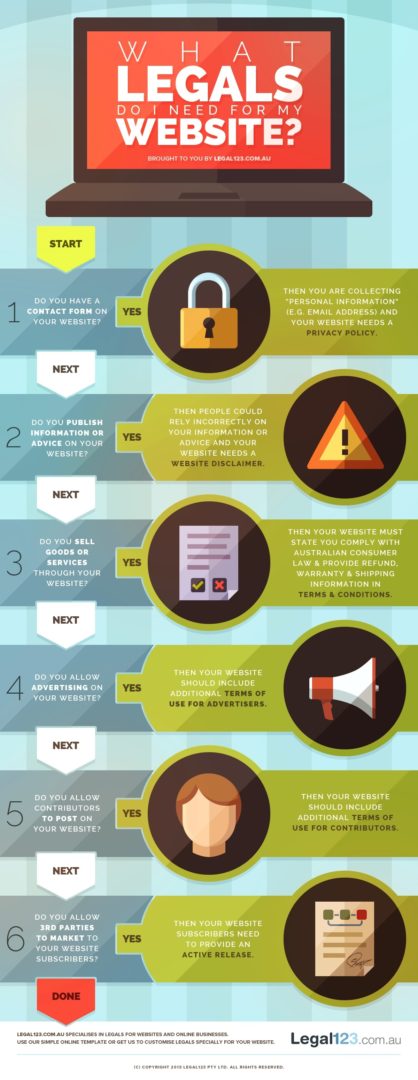
Follow the simple Infographic below, answer 6 simple questions, and you’ll know exactly which legal documents your website needs – or skip the guesswork with our all-in-one Website Legal Package.
Use this Infographic on your website
You are welcome to share this Infographic as long as you only use it for personal (not commercial, i.e. money-making) purposes and you give attribution to Legal123. Download a PDF version of this Infographic here or copy and paste the code below into the HTML of your website:
The 3 Essential Website Legal Requirements in Australia
Most Australian websites must meet three core website legal requirements. Which ones apply depends on what your website does:
- Privacy Policy: Required under the Privacy Act 1988 if you collect any personal information, including email addresses, through a contact form. This covers almost every website.
- Website Disclaimer: Strongly recommended if you publish any information, advice, recommendations or links. It limits your liability when visitors rely on your content, and protects your copyright and intellectual property.
- Terms & Conditions: Required under the Australian Consumer Law if you sell goods or services online. They must set out your refund policy, delivery terms, warranties and consumer guarantees, and are also needed for merchant account approval.
In short, nearly every website needs a Privacy Policy and Disclaimer, and online sellers also need Terms & Conditions.
Here’s a video explaining what legals you need for your website

Work Out Exactly What Your Website Needs: 6 Quick Questions
1. Does your website have a contact form asking visitors to enter their email address or telephone number?
If you do, you’re collecting personal information from your visitors, and you need a Privacy Policy.
A Privacy Policy states that you will keep all personal information safe and secure and will not sell it without their permission. Since almost all websites have contact forms, most websites should have a Privacy Policy. So that should be your first priority.
2. Do you publish information, suggestions, recommendations or advice on your website?
Or do you link to other websites that make recommendations, offer advice or similar? If you do, you should consider protecting yourself from visitors to your website who rely on your information and then try to sue you. You can do this with a Website Disclaimer.
You never know; the information you publish could be outdated, any advice you offer may be misused or misinterpreted by your visitors, and so on. Again, most websites provide information, so you should probably have a general Website Disclaimer to protect yourself and your business.
3. Do you sell goods and services through your website?
If you do, you need to comply with the Australian Consumer Law. This legislation is quite specific and requires that you post clear Terms and Conditions on your website. These should include your refund policy, shipping information, details of the warranty you offer and so on.
In addition, you also need to include a statement that you comply with the Australian Consumer Law. Not all websites sell goods and services, so you might not need to post Terms and Conditions. But the ACCC is cracking down on ecommerce sites in Australia and imposing penalties on non-compliant websites. So don’t get caught out if you sell goods and services online. And if you charge customers on a recurring basis, check what your subscription terms and conditions can legally say, as the ACCC has made subscription traps a 2026-27 enforcement priority.
OK, that’s the first 3 questions. Most websites are covered by these questions and should have a Privacy Policy, a Website Disclaimer and possibly Terms and Conditions if they sell anything online. The next 3 questions cover more specific, specialist website types – such as classified advertising sites and sites that post user-generated content. So let’s cover those briefly.
4. Do you allow people to advertise on your website where your visitors deal directly with them?
For example, if you’re a classified ads website, you should post a Terms of Use for Advertisers statement. This is designed to protect you from misleading ads posted by your advertisers. You don’t want to be responsible for their faulty goods or services, do you?
These additional terms will require advertisers to take responsibility for any claim lodged against you for their advert, products or services. As an aside, if you have ads on your website that you don’t actively manage, have any contact or have anything to do with, for example, Google ads, on your site, then you don’t need any additional Terms for Advertisers.
5. Do you allow others to post content on your website other than just simple comments?
If you do, you must post a Terms of Use for Contributors. Remember, you are responsible for ALL content posted on your website. If one of your contributors has posted copyrighted material, made defamatory comments or taken part in any offensive conduct, you could be liable for ‘enabling’ this to happen.
So protect yourself and your site by having Terms of Use that contributors to your website agree to. These will make them aware that they can’t post copyrighted material, or act inappropriately – and if they do, you have the right to remove the content, make them responsible for any claim and/or ban them from your site. Lastly.
6. Do you allow third parties to market to your subscribers, visitors or customers?
For example, do you share, exchange or sell your customer database of emails or telephone numbers? If you do, you’ll need specific permission from your subscribers, visitors and customers.
The usual way to do this is to get them to tick a box when they’re submitting their contact information, make it clear how you may use their information, and make them aware that someone other than you might email or call them. This is called an Active Release; you may have seen them or been asked to agree before when surfing the Internet.
There we go; we’re all done.
Trusted by 10,200+ Australian businesses
The All-in-One Website Legal Package
Skip the complexity. Get all three documents – Privacy Policy, Disclaimer and T&Cs – drafted by Australian lawyers, ready in 15 minutes. Rated 4.9 stars out of 5 on Google. $199 + GST
As you can see, most websites are covered by the first 3 questions. To summarise, most websites should have, at a minimum, a Privacy Policy and probably a Website Disclaimer. Then, if you’re selling online, you’ll also need Terms and Conditions. Lastly, if you’re one of these niche types of websites where you post user-generated content or are running a classified ads-type site, then you’ll need additional Terms for Contributors and Advertisers.
Which Australian Laws Apply to Your Website?
Your website legal requirements come from four main pieces of Australian legislation:
- Privacy Act 1988: Governs how you collect, use and store personal information. Compliance is handled through your Privacy Policy and the 13 Australian Privacy Principles (APPs). Updated by the 2024 privacy reforms.
- Australian Consumer Law (Competition and Consumer Act 2010): Governs online sales, refunds, warranties and consumer guarantees. Compliance is handled through your Terms & Conditions and enforced by the ACCC.
- Copyright Act 1968: Protects the content you publish and governs your use of others’ material. Your Website Disclaimer asserts ownership of your content and limits your liability for third-party material.
- Spam Act 2003: Governs email and SMS marketing. You must have consent before sending commercial messages, and include an unsubscribe option in every email.
Meeting these requirements isn’t optional – the ACCC actively audits Australian websites and can issue penalties for non-compliance. The good news: a Privacy Policy, Website Disclaimer and Terms & Conditions cover the vast majority of websites.
We hope you found this guide to Website Legal Requirements helpful.
We’re always here to help you at Legal123. And we’ve designed the absolute quickest online templates for generating customised Privacy Policies, Website Disclaimers and Terms and Conditions.
We call it the Legal123 Website Legal Package – three lawyer-drafted documents, customised and on your site in about 5 minutes.
Already have your legals in place? Our fixed-fee website legal review checks your existing site for gaps, missing notices and compliance issues, with a checklist report from a senior Australian lawyer.

About the Author: Vanessa Emilio
Need legal documents written specifically for your business? Vanessa and her team draft custom legal documents for Australian online businesses, or you can book a 30-minute call to talk through what you need.
Disclaimer: We hope you found this article helpful, but please be aware that any information, comments or recommendations are general in nature, do not constitute legal advice and may not be suitable for your specific circumstances. Whilst we try our best to ensure that the information is accurate, sometimes there may be errors or new information that has yet to be included. Any decisions you take based on information on this website are made at your own risk and we cannot be held liable for any losses you suffer. Contact us directly before relying on any of this information.
Website Legal Package from Legal123
Our quick and easy online template generates a customised Privacy Policy, Website Disclaimer and Terms & Conditions.
- Customisable to your business needs
- Choose from 13 different business types
- Answer a few simple questions
- Time to complete: Under 5 minutes
- Lawyer drafted & legally binding
- Easy to use with clear instructions
- Email & telephone support
- Plain English, easy to follow
- Immediate download
Website Legal Package $199 +GST