
Website Privacy Policy Template (Australia)
Lawyer-Drafted Privacy Policy Ready for Your Website in 5 Minutes
The website Privacy Policy your Australian business needs, written for the Privacy Act 1988, the 13 Australian Privacy Principles and the 2024 Amendment Act. Free updates when the law changes. No monthly subscription fees.
Since 2009, our law firm has helped 10,200+ Australian entrepreneurs with easy-to-use legal templates + solutions. Read what 516 clients say about Legal123

How It Works – Compliant in 5 Minutes
Instant Online Access to Your Template
Log in to your Legal123 dashboard after purchase. You will see your Website Privacy Policy generator listed, ready to start. There is nothing to download and nothing to install, so you can work on any device.
Enter Your Website and Contact Details
Enter your website address and your business contact details. That is the entire form. There are no long questionnaires to work through and nothing to write yourself, because the privacy clauses are already drafted and waiting behind the form.
Copy/Paste Your Privacy Policy to Your Website
Your custom Privacy Policy is generated instantly in two paste-ready formats. Choose plain text for any website builder, or the WordPress-ready version with formatting already applied. Paste it in yourself, or email it straight to your web designer.
What’s Included in the Website Privacy Policy Template?
You do not write any of this. Enter your website address and your contact details, and every section below is generated for you.
- What Information Is Collected – Already drafted to cover what Australian websites normally collect: names, email addresses, phone numbers, order and payment details, plus what is gathered automatically (IP address, device and browsing data).
- How That Information Is Used – Pre-written to cover processing orders, managing accounts, customer support, opt-in marketing, improving your site, security and legal obligations.
- Storage, Security & Retention – Standard clauses on keeping information safe and how long it is held, with the retention periods already set out for you.
- Sharing With Third Parties – Covers the services almost every business uses: payment processors, email platforms, hosting, analytics and advertising, including disclosure overseas.
- Cookies – The common cookie types are already listed, along with how visitors opt out of non-essential cookies.
- Automated Tools & AI (new) – A plain-language clause already written to cover product recommendations, fraud screening, chatbots and analytics, in line with the 2024 privacy reforms.
- Children’s Privacy (new) – A ready-made statement that you do not knowingly collect information from under-18s, aligned with the OAIC’s Children’s Online Privacy Code.
- Your Customers’ Rights (new) – Access, correction, deletion and complaints are all covered, plus the new right to take legal action for serious invasions of privacy, effective June 2025.
- Data Breach Response (new) – The Notifiable Data Breaches process is written in for you, including notification to the OAIC.
- Two Paste-Ready Formats – Copy your policy in plain text for any website builder, or a WordPress-ready version that keeps the headings and tables when you paste.
- Online Video Instructions – Watch over my shoulder as I fill in the template. See exactly what to write in each field and how the finished policy is generated.
- Written Instructions – If the online video format isn’t convenient for you, the instructions are also available in a downloadable PDF.
- Telephone Support – We have made the template easy as 1-2-3, but if you get stuck or have a question, we are here to help. Send us an email or give us a call.
- Updates by Email – We don’t overwhelm you with emails, but when the law changes and the template you purchased is updated, we’ll let you know.
- Peace of Mind – Written by a team of qualified Australian lawyers, ensuring your Privacy Policy is legally valid, up to date, and easy to use.
- Free Cookie Consent Notice – Short banner text to notify visitors you use cookies, with Accept and Reject options.
- Single Use – Licensed for use on 1 website only.
How a Free Privacy Policy Template Became a Formal Complaint
The Setup
Megan runs an online homewares store from the Gold Coast. In 2022 she downloaded a free Privacy Policy template, changed the business name at the top, and pasted it into her website footer. It looked fine. It was free. It took five minutes.
Over the next three years, the store grew. She moved onto Shopify, started an email list, added tracking pixels, and installed a chat widget that asks a few qualifying questions before an enquiry reaches her team. Her Privacy Policy never changed.
The Complaint
Megan’s new marketing app pulled phone numbers from past orders and fired off a Black Friday SMS blast. One recipient – who’d bought a single candle two years earlier – replied demanding to know how Megan got their number and lodged a complaint referencing the Spam Act and her Privacy Policy, which said phone numbers were collected “for delivery purposes only.” That line was now evidence against her.
Megan could not point to anything in her policy that covered it.
What followed was two weeks of back-and-forth, a lawyer at hourly rates drafting a proper policy under pressure, and a written response explaining a document she had never read closely. The fix cost many times what a proper policy would have cost her in 2022.
We purchased the Website Privacy Policy.The process was really easy and it gives me peace of mind that its been legally and correctly completed.They have so many services we will definitely use them in the future.

Thank you, Legal 123 I recently purchased your website privacy package for my holiday property website. It was easy to understand, download and purchase. I also found your blogs and the functionality of your site very helpful and easy to navigate. I would recommend this product to others building a website.

Legal 123 were great, I found the website easy to understand, with lots of information. I used the Privacy Policy template and I completed this form within a few minutes.

This is a great, stress free and affordable way of putting a Privacy Policy together for a small Company.

I've found Legal123's services to be very effective and helpful. I was especially impressed that they provide updated templates (in my case, to my Privacy Policy) to reflect changes in the law under their “free updates so you don’t worry about legislation changes” policy. Great value service and highly responsive to queries.

Legal123 saved my bacon! Having an online function to personalise a privacy policy with unlimited changes is a godsend! No having to waste time on the phone getting the sales pitch. Easy to use and found what we needed quickly with the fabulously laid out website. Thanks very much and we will be using your services again!

We were looking for a simple and cost effect way to update our website Privacy Policy. I found Legal123.com.au and did a quick comparison with others and found none of them could match Legal123.com.au for simplicity and cost.

We used legal123 for our Privacy Policy for our website. What a great innovation!! Easy to use, cost effective and we could access our document within minutes! Thank you legal123

Your Privacy Policy saved me a fortune. I did have to tweak a few things with my own solicitor which pertained to our business, not the Privacy Policy itself - in fact, they didn't change anything of the actual template! Good work Legal123.com.au!

Website Privacy Policy Template $99 +GST
What’s Inside the Website Privacy Policy Template
- Time to Complete: 5 minutes
- Includes: Website Privacy Policy, Cookies Consent Notice, Email Disclaimer
- Format: Online form generates two ready-to-paste versions, plain text (any website builder) and WordPress-ready
- Support: Free updates, email & telephone support
- Last Updated: 20 August 2026
- Drafted & Reviewed: Jeremy Climie, Vanessa Emilio
Australian-Specific Provisions
- Australia-wide: Covers NSW, VIC, QLD, WA, SA, TAS, ACT, NT
- Privacy Act: Meets the Privacy Act 1988 and the 13 Australian Privacy Principles
- Automated Decisions: Covers the disclosure rules commencing 10 December 2026
- Overseas Disclosure: Covers cross-border disclosure under APP 8
- Spam Act: Covers email marketing consent and opt-out
- Data Breaches: Explains what happens under the Notifiable Data Breaches scheme
Alternative Names
- Website Privacy Policy
- Website Privacy Notice
- Website Privacy Statement
- Australian Privacy Policy Template
- Privacy Policy Template Australia
- Data Privacy Policy
- Online Store Privacy Policy
- Small Business Privacy Policy
- Privacy Policy for Website
Special Privacy Clauses For
- Classifieds websites
- Consulting websites
- Copywriting websites
- Dietary / Sports Supplements websites
- Ecommerce / Goods & Services websites
- Education / Life Coaching websites
- Financial Broker websites
- Fitness / Exercise websites
- Food / Catering websites
- Graphic Design websites
- Home Design / Renovation websites
- Photography websites
- Tradie websites, and
- Web Development websites
Not Suitable For
- International websites (non-Australian)
- Mobile apps (use our App Legal Package instead)
- Health service providers with specific record-keeping obligations
Further Information
- Privacy Policy Australia: The Complete Guide
- Does Your Small Business Need a Privacy Policy?
- Do I Need a GDPR Privacy Policy?
- Website Legal Package: T&Cs, Privacy Policy and Disclaimer
- What Legals Do I Need for My Website?
- What Legals Do I Need for My Ecommerce Business?
- Do I Need a Website Disclaimer for My Website?
- Get Your Website Legals Reviewed by a Lawyer
Privacy Policy Requirements for Australian Websites
Australian websites need a privacy policy if the business collects personal information, and email addresses count. The Privacy Act 1988 (Cth) and the 13 Australian Privacy Principles set the rules. Australian Privacy Principle 1.3 requires a clearly expressed and up to date privacy policy, available free of charge to anyone who asks.
Do I need a privacy policy on my website in Australia?
Yes, if your website collects personal information. Personal information includes names, email addresses, phone numbers, delivery addresses, IP addresses, and anything else that can reasonably identify someone.
- Contact forms and email signups – collecting a name and an email address is collecting personal information
- Online stores – checkout details, delivery addresses and order history
- Analytics, tracking pixels and chat widgets – IP addresses and behavioural data collected automatically, often without you setting it up deliberately
The Privacy Act currently exempts most businesses turning over less than $3 million a year, but that exemption is narrower than people assume and it is scheduled to be removed. It does not apply if you provide a health service, disclose personal information for a benefit, hold a Commonwealth contract, or are related to a covered company.
In our experience working with over 10,000 Australian businesses, the exemption rarely matters in practice. Shopify, Stripe, PayPal, Meta, Google and the Apple and Google app stores all require a published privacy policy before you can use them, regardless of your turnover.
How do I write a privacy policy for my website?
Start with what your business actually does, not with a template you found. List every tool that touches customer data: your website forms, email platform, payment processor, analytics, chat widget, booking system and cloud storage.
Then write the eight elements above against that list. Say where the data goes, including overseas. Use plain language, because Australian Privacy Principle 1.3 requires the policy to be clearly expressed.
Most business owners get stuck at the overseas disclosure and automated decision sections, because that means auditing tools they never chose deliberately. Our online form asks the questions for you and builds those clauses from your answers.
What a free privacy policy template cannot do
A free template gives you a document. It does not give you the three things that actually protect you.
It cannot keep up with your business. Every free template is a snapshot. The moment you add a booking system, an email list, a payment processor or an AI tool, the document is out of date and nobody tells you.
It cannot keep up with the law. Australian privacy law has moved twice in two years and it is not finished.
The statutory tort for serious invasions of privacy commenced on 10 June 2025. It applies to entities that are not even covered by the Australian Privacy Principles, so the small business exemption is no defence to being sued by a customer directly.
Since 11 December 2024 the Office of the Australian Information Commissioner (OAIC) has been able to issue infringement notices and compliance notices without running a full determination first.
From 10 December 2026, privacy policies must disclose automated decision-making. If any computer program helps decide something about a person, your policy must say what information it uses and what kinds of decisions it makes.
The $3 million small business exemption is still in force, but it is scheduled for removal. When it goes, roughly 2.3 million more Australian businesses come into full obligations.
It cannot show that you took it seriously. In February 2026 the Administrative Review Tribunal handed down its decision on Bunnings and facial recognition technology. Bunnings won the hard question, because the Tribunal accepted it was entitled to use the technology to deal with serious retail crime.
Bunnings lost on the paperwork. The Tribunal found the use was not properly notified to customers and that appropriate policies and procedures were not in place to govern it. A national retailer with a full legal department was right on the substance and still lost on the documents.
What privacy policy is required for a website?
An Australian website privacy policy must set out eight things. Each one comes directly from the Australian Privacy Principles.
Each of the eight elements below comes directly from the Australian Privacy Principles:
- Identity: your business name, ABN or ACN, and contact details
- Collection: what personal information you collect and how you collect it
- Purpose: why you collect it, and how you use and disclose it
- Storage and security: how you protect it from misuse, loss and unauthorised access
- Overseas disclosure: which countries you are likely to send personal information to
- Access and correction: how someone asks to see or fix the information you hold about them
- Complaints: how someone complains about a privacy breach, and how you will handle it
- Automated decisions: what personal information feeds computer programs that make decisions about people, and what kinds of decisions they make. This applies from 10 December 2026.
Miss any of these and your policy is not compliant, even if it reads well. Failing to keep a clearly expressed and up to date policy containing everything required under Australian Privacy Principle 1.4 carries penalties of up to $66,000.
Cross-border disclosure is where most Australian privacy policies fall down. If you use Google Analytics, Mailchimp, Klaviyo, Shopify, Stripe or almost any cloud host, personal information is leaving Australia and Australian Privacy Principle 8 requires you to say so.
Can you provide an example of a website privacy policy?
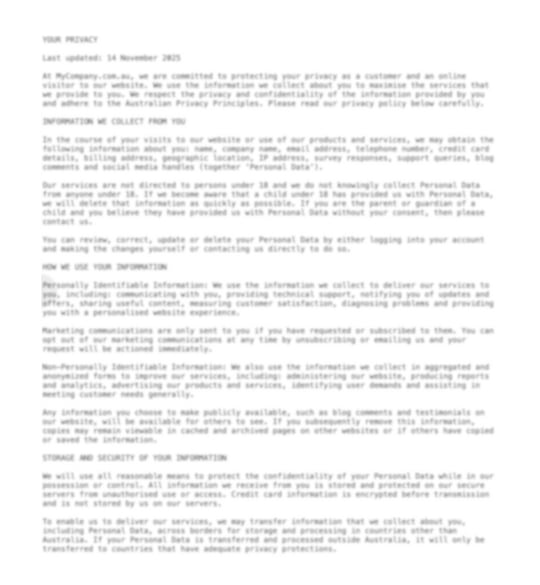
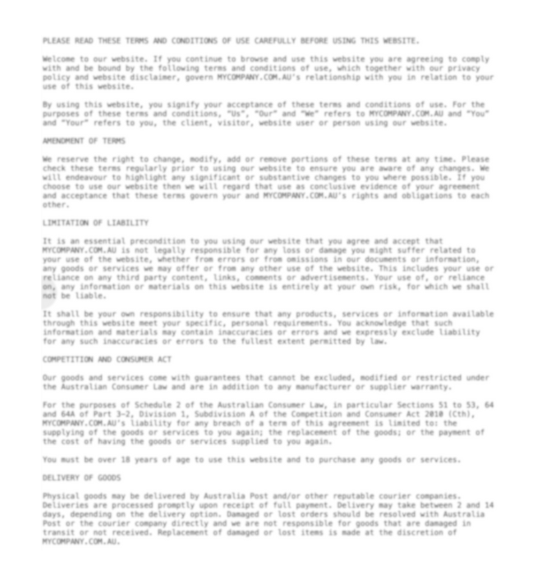
Yes. The sample above shows page one of the Website Privacy Policy Template as it is generated, so you can see the structure and language before you buy.
Be careful copying a published privacy policy from another website. It describes their business, their tools and their overseas disclosures, not yours. Copying it word for word usually creates the exact problem it was meant to solve, because the document no longer matches what you actually do.
The generated document also gives you the plain-language wording the Australian Privacy Principles require. A policy that is technically complete but unreadable still fails Australian Privacy Principle 1.3.
Which Australian states and territories does it cover?
All of them. Privacy for private sector businesses is governed federally by the Privacy Act 1988 (Cth), so one policy covers New South Wales, Victoria, Queensland, Western Australia, South Australia, Tasmania, the Australian Capital Territory and the Northern Territory.
You do not need a different privacy policy for each state. You do need one written for Australian law, which is why an American or British template will not do the job.
State-based privacy laws do exist, but they apply to state government agencies and their contractors rather than to ordinary private sector businesses. If you run a business website, the Privacy Act 1988 is the law that applies to you.
Where to put your privacy policy on your website
A privacy policy only works if people can actually find it. Australian Privacy Principle 1.5 requires you to make it available free of charge and in an appropriate form.
- Footer Links: Create a separate page for your Privacy Policy and link to it from the footer on every page of your website.
- Contact Forms: Include “By submitting, you agree to our Privacy Policy” with a clickable link.
- Email Signup: Link to your Privacy Policy next to every email capture box.
- Checkout: Link to your Privacy Policy on the checkout page, alongside your Terms and Conditions.
- Cookie Popup: Display a cookie consent pop-up when visitors first arrive if you use tracking tools, and link the Privacy Policy from it.
Review the policy whenever your data handling practices change. That is the step almost everybody skips, and it is the step that turns a compliant policy into a non-compliant one.
Frequently Asked Questions
Why should I pay for this when I can use a free privacy policy template?
Free templates have three fatal flaws: they are usually written for US or UK law, they are frozen the day you download them, and nobody updates them when your business or the law changes.
Our Website Privacy Policy Template is drafted by Australian lawyers for the Privacy Act 1988 and the 13 Australian Privacy Principles. When the law changes, we update the template and email you. That has already happened twice in two years.
What happens if I don’t have a privacy policy on my website?
Three things go wrong.
Regulatory risk: failing to keep a clearly expressed and up to date privacy policy breaches Australian Privacy Principle 1, with penalties of up to $66,000. Serious or repeated interference with privacy carries penalties of up to $50 million.
Platform rejection: Shopify, Stripe, PayPal, Meta, Google Ads and both app stores require a published privacy policy. No policy often means no payment processing and no advertising.
No defence: when a customer complains, the first thing you are asked for is your privacy policy. If it does not describe what you actually do, it works against you rather than for you.
How long does it take to set up?
About 5 minutes.
Log in to your Legal123 dashboard, answer 7 basic questions about your business, and select your business type from the list.
You instantly get your Privacy Policy in two paste-ready formats: plain text for any website builder, and WordPress-ready with formatting applied. No lawyer appointments, no waiting weeks.
Will the formatting break when I paste it in?
No, and that is the most common problem with free templates, which we have deliberately solved. Each document comes in two versions.
The plain text version pastes cleanly into any website builder including Squarespace, Wix and Shopify. The WordPress-ready version keeps the headings and structure intact when you paste it into a WordPress page.
Where do I put my privacy policy on my website?
Footer Links: Create a separate Privacy Policy page and link to it from the footer on every page.
Contact Forms: Include “By submitting, you agree to our Privacy Policy” with a clickable link.
Email Signup: Link to it next to every email capture box.
Checkout: Link to it on your checkout page.
Cookie Popup: Use the free Cookies Consent Notice in a website pop-up if you use tracking tools.
Can I modify the template?
Yes, and you should update it whenever your business changes. The template is comprehensive and covers most situations, but if you modify core clauses you risk creating gaps in your protection.
If your business does something unusual with personal information, book a call and we will tell you what needs to change.
What if Australian privacy law changes?
You get free lifetime updates. We update the template when the law changes and we notify you by email. No annual fees and no re-purchase.
This matters more than it sounds. The automated decision-making disclosure rules commence on 10 December 2026, and the small business exemption is scheduled for removal after that. Every free template on the internet will be out of date and nobody will tell the people who downloaded it.
Is this enforceable if something goes wrong?
Yes. Our privacy policy is drafted by Australian lawyers, complies with current Australian privacy law, and is used by more than 8,000 Australian businesses.
A privacy policy is not a contract you enforce against someone. It is the document that demonstrates you met your obligations under the Privacy Act 1988. Its value shows up the moment a customer complains or a regulator asks.
Can I use this on multiple websites?
No. It is licensed for single use on one website only. If you operate multiple websites, purchase a separate template for each one.
If you are a website developer or designer, you can earn a commission for referring your clients to us. Get in touch and we will set that up.
Is this a one-time cost or a subscription?
One-time $99 +GST. Free updates, no hidden fees, no annual renewals and no per-use charges.
Most privacy policy generators charge monthly and stop working the day you stop paying. Yours does not.
Do I need a privacy policy if my turnover is under $3 million?
Probably yes, for two reasons.
First, the small business exemption is narrower than most people think. It does not apply if you provide a health service, disclose personal information for a benefit, hold a Commonwealth contract, or are related to a covered company. It is also scheduled to be removed.
Second, the statutory tort for serious invasions of privacy commenced on 10 June 2025 and applies to entities that are not covered by the Australian Privacy Principles at all. The exemption is no defence to being sued directly by a customer.
On top of that, your payment processor and advertising platforms will require a privacy policy whatever your turnover.
What if I’m not satisfied with the template?
We guarantee that our legal documents are legally sound for the circumstances described in the product details.
If a technical issue prevents you from using the template, we will refund you. If you are stuck, call us and we will help you finish it.
Website Privacy Policy Template $99 +GST
Are you a Website Designer or Developer? Our templates are for single/personal use only. If you would like to earn a commission for referring your clients to use our Website Legal Package on their own websites, then why not join our Affiliate Program.