
How to Run a Compliant Telehealth Practice: A Guide for Psychologists, Psychiatrists & Counsellors [2026]
Last updated: 13 April 2026
What You Need to Know
Running a compliant telehealth practice in Australia requires meeting the same AHPRA professional standards as face-to-face care, plus additional obligations around informed consent, technology platforms, privacy, and (for psychiatrists) prescribing rules.
- AHPRA: AHPRA requires the same professional standards for telehealth as face-to-face care, and you (not your employer or platform) are personally responsible for compliance
- Code of Conduct: The Psychology Board’s new Code of Conduct (1 December 2025) now requires informed consent as an ongoing process and mandatory cultural safety requirements, both of which directly change how you deliver telehealth
- Counsellors: Counsellors aren’t AHPRA-registered, but the Privacy Act 1988 still applies if you collect health information, and the Australian Consumer Law prohibits misleading claims about your qualifications
- Schedule 8: Psychiatrists can prescribe via telehealth after a real-time consultation, but Schedule 8 medications (ADHD stimulants, benzodiazepines) have state-by-state restrictions that may require an initial face-to-face assessment
- Online Platforms: Your telehealth platform must use end-to-end encryption and comply with the Australian Privacy Principles, and you should verify where client data is stored
- Medicare: Medicare Better Access item numbers are permanently available for telehealth mental health services, but the patient must have had a face-to-face consultation within the last 12 months
In our experience helping over 10,200 Australian businesses get their legal documents right, mental health practitioners consistently underestimate the documentation side of telehealth. Consent forms, privacy policies, and service agreements are where most compliance gaps sit.
Click on any of the questions below to jump to that section of this ‘How to Run a Compliant Telehealth Practice’. Click these links to go to our:
- Legal Guide for Psychologists
- Legal Guide for Psychiatrists, and
- Legal Guide for Counsellors & Therapists
Telehealth compliance issues covered
If, after reading this guide, you still have a question, get in touch, as we’d love to keep adding your questions to this comprehensive guide.
AHPRA Telehealth Guidelines for Mental Health Practitioners
AHPRA’s position on telehealth is straightforward: you must meet the same professional standards whether you’re sitting across from a client or on a screen. There is no separate “telehealth licence” in Australia. Existing healthcare laws and your profession’s regulatory standards apply to telehealth in exactly the same way as they do to in-person care.
The critical point that catches practitioners out is that you are personally responsible for the healthcare you provide via telehealth. Not your employer, not the platform provider, not your practice manager. You.
AHPRA updated its telehealth guidance in October 2025, reinforcing that patient safety is the central consideration. Your AHPRA registration is national, which means you can provide telehealth services to clients anywhere in Australia. However, you must notify AHPRA of your practice locations, comply with state-based laws (including mandatory reporting and WorkCover), and ensure your insurance covers interstate services.
How does telehealth work in Australia?
Australia has no standalone telehealth legislation. Instead, existing laws that govern healthcare delivery apply equally to telehealth. AHPRA’s guidelines set the compliance framework, and each National Board (Psychology Board, Medical Board) adds profession-specific expectations.
In practice, this means your obligations include:
- Maintaining the same clinical standards as face-to-face care
- Obtaining informed consent that specifically covers telehealth risks
- Using technology that meets privacy requirements
- Keeping records to the same standard as in-person sessions
- Having emergency protocols for situations where a client is at risk during a remote session
Who is not appropriate for telehealth?
Not every client or situation is suitable for telehealth. AHPRA’s guidance is clear: telehealth is generally most appropriate in the context of a continuing clinical relationship that also involves in-person consultations.
You need to assess clinical appropriateness for each client. Telehealth may not be suitable when:
- A client is in acute crisis, and you cannot ensure their physical safety
- A reliable clinical assessment requires physical examination (relevant for psychiatrists conducting initial assessments)
- The client lacks access to appropriate technology or a private space
- The therapeutic relationship hasn’t been established, and the clinical situation is complex
We see practitioners regularly overlook the emergency protocol requirement. If a client discloses suicidal ideation during a telehealth session, you need to know their physical location and have a plan. Document this protocol and discuss it with every telehealth client upfront.
Video vs telephone consultations: What AHPRA expects
AHPRA’s position is that video consultations are preferred over telephone consultations where clinically appropriate. Video allows you to observe non-verbal cues, assess mental state more comprehensively, and build therapeutic rapport more effectively.
Telephone consultations may be appropriate when the client does not have access to video technology, technical difficulties prevent a video connection, the session content does not require visual observation, or the client explicitly prefers telephone, and this is clinically appropriate.
Protect Your Practice and Your Peace of Mind
Running a therapy practice requires more than just clinical skills; it requires a solid legal foundation. We specialise in drafting custom legal documents for Australian psychiatrists, psychotherapists, counsellors and therapists. We ensure you are fully compliant with Australian Privacy Principles (APPs) and industry codes of ethics.
Request a QuoteThe key compliance point: if you conduct a telephone consultation instead of a video, document your clinical reasoning for why a telephone consultation was appropriate for that specific session. “The client preferred it” is not sufficient on its own – you need to note why that preference was clinically acceptable given their presentation.
Medicare treats these differently, too. Video and telephone consultations have different MBS item numbers and different rebate amounts. Using a video item number for a telephone consultation is incorrect claiming and a Medicare audit trigger.
What Changed in 2025: New Psychology Code of Conduct and Updated AHPRA Guidance
Two significant regulatory changes in late 2025 directly affect telehealth practice for mental health practitioners.
The Psychology Board’s new Code of Conduct came into effect on 1 December 2025, replacing the Australian Psychological Society’s (APS) Code of Ethics that had guided the profession since 2007. This is the most significant regulatory change for Australian psychologists in 15 years.
The key shift: the old APS Code was principles-based ethical guidance. The new Code is a prescriptive, enforceable standard under AHPRA. That means specific obligations now carry regulatory weight, and breaches can trigger formal complaints and disciplinary action. Three changes have direct telehealth implications:
Enhanced informed consent is an ongoing process. Consent is no longer a one-time form at intake. The new Code requires you to treat consent as ongoing, revisiting it as circumstances change. For telehealth, this means checking in about whether the format is still working for the client, whether their privacy situation has changed, and whether technology issues are affecting the therapeutic relationship.

Did you set up your practice before December 2025?
If you set up your telehealth practice before December 2025, your consent processes and documentation may no longer meet the new Code of Conduct requirements. Review your telehealth consent form and client information materials against the new Code now.
Mandatory cultural safety for First Nations practice. If you’re providing telehealth to Aboriginal and Torres Strait Islander clients, the new Code sets explicit requirements around cultural safety. This includes understanding that telehealth may create additional barriers for some First Nations clients, particularly in remote communities.
Expanded supervisor accountability. If you’re supervising provisionally registered psychologists who deliver telehealth, you now have explicit obligations around ensuring they meet telehealth compliance standards.
The October 2025 AHPRA telehealth update reinforced that patient safety is paramount in telehealth delivery. The updated guidance places additional emphasis on practitioners ensuring their chosen technology platform meets both clinical needs and privacy requirements, and reminds practitioners that they must be competent in using their telehealth tools.
Informed Consent and Privacy Requirements for Telehealth
Consent and privacy are the backbone of documentation for a compliant telehealth practice. Get these wrong, and you have a compliance gap that affects every single client interaction.
For telehealth, informed consent goes beyond what you’d cover for in-person sessions. Your telehealth consent must specifically address:
- The limitations of remote assessment (what you might miss without being in the room)
- Privacy risks of technology (data transmission, platform security, sessions being overheard at the client’s end)
- What happens when technology fails mid-session (your reconnection protocol)
- Emergency procedures (how you’ll respond if the client is at risk and you’re not physically present)
- Recording and data storage policies
- The client’s responsibilities (private space, stable internet, backup contact method)
The Privacy Act 1988 and the Australian Privacy Principles (APPs) apply to all private health service providers, including sole practitioners. Health information is subject to a higher degree of privacy protection than other personal information under Australian law. State-specific legislation adds additional layers: the Health Records and Information Privacy Act 2002 in NSW, the Health Records Act 2001 in Victoria, and equivalent legislation in other states.

Telehealth-Specific Consent Form
We recommend using a separate telehealth-specific consent form rather than adding a generic clause to your standard consent form. It needs to cover technology risks, privacy limitations, emergency protocols, and what happens when the connection drops mid-session. A comprehensive telehealth consent form protects both you and your client.
Record retention requirements: keep all client records for at least 7 years for adult clients, or until the client turns 25 for minors (whichever is longer).
What are the disadvantages of using telehealth?
The main disadvantages of telehealth for mental health practice are limitations on clinical assessment, privacy and security risks, technology reliability issues, and challenges in managing emergencies remotely.
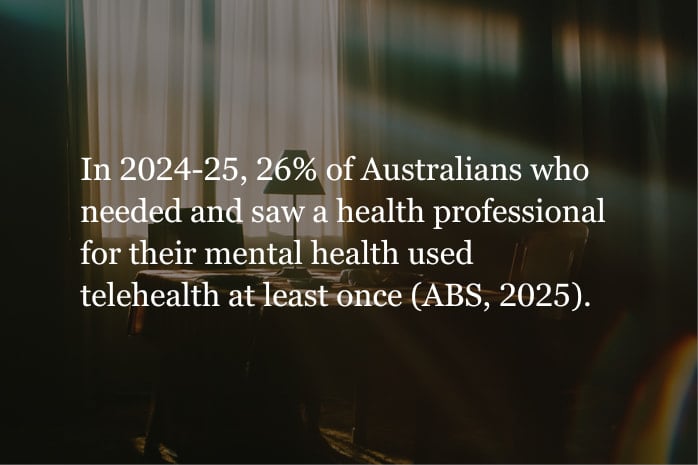
From a compliance perspective, the disadvantages matter because they’re exactly what your consent form needs to disclose. You can’t fully assess body language via video. You can’t control whether someone else is in the room at the client’s end. If the internet drops during a crisis disclosure, you need a plan. And if you’re a psychiatrist, you can’t conduct a physical examination remotely, which affects initial assessments and medication reviews.
Being upfront about these limitations in your consent documentation isn’t a weakness. It’s good clinical governance, and it protects your registration.
What must be in your telehealth consent form?
A telehealth consent form must cover matters that don’t arise in face-to-face practice. At a minimum, your consent should address:
- Description of how telehealth sessions will be conducted
- Technology requirements the client needs to meet
- Privacy limitations inherent in electronic communication
- Your recording policy
- Emergency procedures, including what happens if the client experiences a crisis
- Emergency contact details for someone who can physically check on the client
- Requirement for the client to disclose their physical location at each session
- Technology failure procedures (what happens if the connection drops mid-session)
- Fees and cancellation policy specific to telehealth, and
- Client’s right to request in-person services at any time.
Two points practitioners consistently miss. First, location disclosure. You need to know where the client is sitting during the session – not just for emergencies, but because different states have different mandatory reporting thresholds, and the laws of the state where your client is located are the ones that apply. Second, the technology failure procedure. If the connection drops mid-crisis, you need a documented plan that your client has already agreed to, not a decision you’re making under pressure.
Sign before the first telehealth session
Have clients sign the telehealth consent form before their first telehealth session, not during it. And treat consent as ongoing – if the client’s circumstances change (they move interstate, their mental health deteriorates, their home environment changes), revisit whether telehealth remains appropriate and document that conversation.
What legal documents do you need for a telehealth practice?
Every telehealth practice needs a core set of legal documents beyond standard in-person practice paperwork. At a minimum, you need these seven documents in place before your first telehealth session.
- Telehealth service agreement (or addendum) – covers the scope of telehealth services, technology requirements and responsibilities, geographic limitations, and whether fees differ from in-person sessions
- Telehealth informed consent form – separate from your service agreement, covering limitations of remote assessment, privacy risks of electronic communication, emergency procedures, location verification, and technology requirements. Have clients sign this before their first session, not during it
- Updated privacy policy – must address what additional data you collect for telehealth (location, emergency contacts), which platform you use, where data is stored, and how you protect information during transmission
- Crisis management protocol – a written protocol reviewed annually, accessible during all sessions, and shared with any staff who support your telehealth practice
- Technology failure procedures – documented steps for connection drops (reconnect, call mobile within 2 minutes, SMS if unreachable, escalate to crisis protocol after 10 minutes), platform outages, and audio/video quality issues
- Session recording consent (if applicable) – covering purpose, access, retention, storage, and the client’s right to refuse. Recording laws differ by state, so your consent process must comply with local surveillance legislation
- Third-party presence consent – documenting who is present during sessions, client consent to their presence, and the support person’s understanding of confidentiality requirements
Telehealth Compliance for Counsellors and Therapists
This is where it gets different. Counsellors and therapists are not regulated by AHPRA, and “counsellor” is not a protected title in Australia. That doesn’t mean there are no rules. It means the rules come from different places.
Can anyone call themselves a counsellor in Australia?
Yes, “counsellor” is not a protected title under the National Registration and Accreditation Scheme. Anyone can technically use the title. However, accreditation with a recognised professional body is strongly recommended and, in practice, is becoming essential.
The Australian Counselling Association (ACA) and the Psychotherapy and Counselling Federation of Australia (PACFA) are the two main accreditation bodies. Accreditation matters for telehealth because it affects your eligibility for professional indemnity insurance (many insurers require it), your ability to receive referrals from GPs under certain programs, your credibility with clients and referral sources, and your access to telehealth platforms that require practitioner credentials.
Do counsellors need to be registered in Australia?
No, there is no mandatory registration for counsellors in Australia. Unlike psychologists (who must be registered with the Psychology Board of Australia through AHPRA) and psychiatrists (who must hold medical registration), counsellors operate under voluntary self-regulation.
That said, voluntary registration with ACA or PACFA sets the professional standards for your practice, including telehealth delivery. Both bodies have codes of ethics and practice standards that address telehealth, and both require ongoing professional development.
What accreditation should a counsellor have in Australia?
A counsellor in Australia should hold accreditation with either the Australian Counselling Association (ACA) or the Psychotherapy and Counselling Federation of Australia (PACFA). Both require minimum qualifications (typically a diploma or degree in counselling), supervised practice hours, ongoing professional development, and adherence to a code of ethics.

You Still Have Compliance Obligations
Just because counsellors aren’t AHPRA-registered doesn’t mean there are no compliance obligations. The Privacy Act 1988 still applies to your practice if you collect health information. The Australian Consumer Law means you can’t make misleading claims about your qualifications or services. And your professional indemnity insurance will have specific conditions about telehealth delivery that you need to meet.
For telehealth specifically, check your accreditation body’s requirements around technology standards, client consent, and record-keeping. ACA and PACFA both expect members to maintain the same professional standards in telehealth as in face-to-face practice.
Prescribing Medications via Telehealth in Australia
This section is primarily for psychiatrists, though psychologists and counsellors should understand the framework to coordinate effectively with prescribing practitioners.
Can telehealth prescribe prescriptions?
Yes, a medical practitioner (including a psychiatrist) can legally prescribe medication following a real-time telehealth consultation conducted via video or phone. The prescription must be clinically appropriate, and the practitioner must have conducted an adequate assessment.
The Medical Board of Australia’s guidelines are clear that prescribing based solely on an online questionnaire, without a real-time consultation, is not consistent with good medical practice. You must have a direct, real-time interaction with the patient before prescribing.
What medications cannot be prescribed online?
Most medications can be prescribed via telehealth after an appropriate clinical assessment. However, Schedule 8 (controlled) medications have significantly stricter requirements, and the rules vary by state.
Schedule 8 medications relevant to psychiatry include stimulants for ADHD (dextroamphetamine, methylphenidate, lisdexamfetamine), benzodiazepines, and some opioid medications. Some states require at least one face-to-face consultation before a psychiatrist can prescribe Schedule 8 medications via telehealth. Others require ongoing face-to-face reviews at specified intervals.
The state-by-state variation is the biggest compliance trap in telehealth prescribing. What’s permissible in NSW may not be in Queensland or Victoria. Always check the current requirements in the state where your patient is physically located at the time of the consultation.
Can ADHD medication be prescribed over telehealth?
Yes, ADHD medication can be prescribed via telehealth, but with significant caveats. Stimulant medications for ADHD (dextroamphetamine, methylphenidate, and lisdexamfetamine/Vyvanse) are Schedule 8 controlled substances in Australia.
The requirements vary by state, but common requirements include an initial comprehensive assessment (some states require this to be face-to-face), an authority or permit to prescribe stimulants (required in most states), ongoing monitoring and review, and compliance with real-time prescription monitoring (RTPM) systems where they operate.
From what we’ve seen, the practitioners who run into trouble are those who assume the rules in one state apply nationally. They don’t. If you’re prescribing stimulants to a patient in a different state from your usual practice, check that state’s requirements before writing the prescription.
What is real-time prescription monitoring in Australia?
Real-time prescription monitoring (RTPM) is a system that gives prescribers and pharmacists access to a patient’s recent prescription history for monitored medications. It is designed to reduce harm from pharmaceutical misuse.
RTPM is operational in Victoria (SafeScript), New South Wales, Queensland, South Australia, Tasmania, and the ACT. The systems are progressively being linked nationally. For psychiatrists prescribing Schedule 8 medications via telehealth, RTPM adds an obligation to check the system before prescribing and to comply with the alert and override requirements in each state’s system.
Choosing a Compliant Telehealth Platform
Your telehealth platform is not just a convenience tool. It’s part of your clinical infrastructure, and it needs to meet specific compliance requirements.
When evaluating platforms, consider:
- End-to-end encryption (non-negotiable for health consultations)
- Data sovereignty (where is client data stored, and is it on Australian servers?)
- The platform’s privacy policy and whether it complies with the Australian Privacy Principles
- Clinical features like virtual waiting rooms, screen sharing, and session notes
- Whether the platform has a Business Associate Agreement or equivalent data processing agreement
- Integration with your practice management and billing software
Where most practitioners get stuck!
Based on the legal documents we’ve helped mental health practices create, the platform question is where most practitioners get stuck. Purpose-built Australian health platforms like Coviu and Healthdirect Video Call are designed with privacy compliance in mind.
If you’re using Zoom or Microsoft Teams, check that your plan meets the Australian Privacy Principles and verify where client data is stored. A consumer Zoom account and a Zoom for Healthcare account have very different compliance profiles.
What are the most common telehealth compliance mistakes?
Most telehealth compliance failures stem from seven avoidable mistakes. Here’s what to check before they become audit triggers or complaints.
- Using non-compliant platforms – Consumer apps like Skype, FaceTime, and WhatsApp lack the encryption, audit trails, and business associate agreements required for healthcare. Use a healthcare-specific platform (Coviu, Healthdirect Video Call, or enterprise healthcare versions of mainstream platforms). Budget $30-50/month — non-negotiable
- Not verifying client location at each session – Clients travel. Without asking, you won’t know where they are, and that matters for emergency response, jurisdictional compliance, and clinical appropriateness. Build it into your session opening: “Can you confirm where you’re located today?”
- No documented crisis protocol – AHPRA recorded 586 telehealth-related notifications in 2024-25 alone. Create a written crisis protocol before your first session, review it annually, and have it accessible during every session
- Assuming insurance covers telehealth automatically – Policies have specific coverage territories and may exclude certain practice modes. Contact your insurer in writing and ask: does my policy cover telehealth, are there territorial limits, and are any activities specifically excluded? Keep the written response
- Providing telehealth to clients in jurisdictions where you’re not covered – When a client relocates interstate or overseas, check with your insurer before continuing sessions. Most policies exclude international clients entirely
- Inadequate record-keeping for remote sessions – Telehealth notes need additional fields beyond standard clinical notes: mode of delivery, client’s confirmed location, any technology issues, whether emergency contact information was confirmed, and any assessment limitations due to telehealth delivery
- Not updating consent when circumstances change – Consent is not one-and-done. Revisit telehealth suitability when a client’s presentation changes significantly, when they move to a new location, at regular intervals (annually minimum), and when your platform or procedures change
Medicare and Billing for Mental Health Telehealth
Medicare telehealth items for mental health services are permanently available under the Better Access initiative. This means video and phone consultations can be billed to Medicare for eligible patients, making telehealth accessible to more Australians.
Key Medicare requirements for telehealth mental health services:
- Existing relationship rule: To bill Medicare for a telehealth GP consultation, the patient must have had a face-to-face consultation with the practitioner (or another practitioner at the same practice) within the last 12 months. This rule ensures telehealth supplements rather than replace in-person care.
- Better Access items: Psychologists, clinical psychologists, and psychiatrists can claim specific MBS item numbers for telehealth consultations under the Better Access initiative. The patient needs a valid Mental Health Treatment Plan or referral from their GP.
- Rural loading: MBS item 294 applies a 50% fee loading to bulk-billed psychiatry consultations delivered by video telehealth to patients in regional and rural areas.
- Video vs. phone: Both video and phone consultations are eligible, though some item numbers specify video only. Check the current MBS schedule for the specific items relevant to your profession.

Get your Medicare billing set up right
In 2024-25, 34.4% of Australians who needed mental health care delayed or did not see a professional at least once, with cost being a factor for 19.7% of those delays (ABS, 2025). Telehealth with Medicare bulk billing directly addresses this access barrier, which is one reason why getting your billing set up right matters beyond just compliance.
Practising Across State Borders and Internationally
AHPRA registration is national, which means you can provide telehealth services to clients in any Australian state or territory. But national registration doesn’t mean national law. You still need to comply with the laws of the state or territory where your client is physically located.
Key state-based obligations include Mental Health Act requirements (which vary by state), mandatory reporting thresholds and processes, WorkCover and workers’ compensation requirements, and (for psychiatrists) state-specific prescribing regulations for controlled substances.
Your professional indemnity insurance must cover you for telehealth across all jurisdictions where you see clients. Check your policy. Some policies have geographic limitations that don’t account for interstate telehealth.
Can I provide teletherapy from another country?
If you’re treating clients located in Australia, you must be registered with AHPRA (for psychologists and psychiatrists) regardless of where you’re physically sitting. An overseas practitioner treating Australian-based clients without AHPRA registration is practising illegally.
If you’re an Australian-registered practitioner treating clients located overseas, the rules get more complex. You need to check the registration and licensing requirements of the country where your client is located. Some countries require local registration. Your professional indemnity insurance may not cover international practice. Privacy laws in the client’s country may impose additional obligations.
For counsellors (who aren’t AHPRA-registered), the same jurisdictional considerations apply through different channels: your insurance coverage, your professional body’s standards, and the consumer protection laws that apply in each jurisdiction.
Can telehealth be used internationally?
Yes, telehealth can be used internationally, but with significant regulatory complexity. The key question is always: which country’s laws apply?
As a general principle, the laws that apply are those of the jurisdiction where the patient is physically located at the time of the consultation. This means if you’re an Australian practitioner providing telehealth to a client who is temporarily overseas, you may need to consider both Australian and foreign regulatory requirements.
For most mental health practitioners, the practical advice is to limit your telehealth practice to clients in Australia unless you have specific legal advice regarding international practice.
Other Frequently Asked Questions
Does professional indemnity insurance cover telehealth?
Not automatically. Most current policies cover telehealth, but older policies may not, and many have territorial limitations. Ask your insurer these questions in writing and keep the response:
Does my policy cover telehealth (video and telephone)?
Am I covered for clients in other Australian states? Overseas?
Are any countries excluded? (USA/Canada exclusions are common)
Does my policy cover cyber incidents or data breaches?
Watch for gaps: Many policies exclude overseas clients entirely. Extended trips abroad may void coverage. And if you retire, confirm your run-off cover includes telehealth – claims can surface years later.
What are the disadvantages of telepsychiatry?
The main disadvantages of telepsychiatry are limitations on physical assessment (relevant for medication reviews and initial diagnostic assessments), prescribing restrictions for controlled substances, challenges in managing psychiatric emergencies remotely, and reduced non-verbal communication cues. For psychiatrists, the prescribing restrictions are the most significant practical limitation, particularly the state-by-state variation in Schedule 8 prescribing rules discussed earlier in this guide.
Can I use AI transcription tools in telehealth sessions?
Proceed with caution. AHPRA’s October 2025 telehealth guidance specifically addresses AI tools in clinical settings, and the compliance questions are real.
Before using any AI transcription tool, you need clear answers to: where does the transcription data go, who has access to it, is it stored on Australian servers, does it comply with the Australian Privacy Principles, and have you obtained specific written consent from the client for AI processing of their session content?
The safest approach is to use only AI transcription tools from established healthcare technology providers that can demonstrate compliance with Australian privacy laws. Disable AI features on consumer platforms entirely – some telehealth platforms have automatic transcription enabled by default, which means client session content may be processed through overseas AI services without your knowledge or consent.
If you use AI transcription, explicitly include it in your telehealth consent form. Generic consent to telehealth does not cover AI processing of session content. This needs its own disclosure and its own consent.
What if my internet drops mid-session?
Follow your documented technology failure procedure – and if you don’t have one, that’s the first problem to fix.
The protocol should be to attempt reconnection via the same platform immediately. If that fails within 60 seconds, call the client’s mobile phone. If they don’t answer, send an SMS letting them know you’re trying to reconnect. If you cannot reach the client within 10 minutes, assess whether they were in distress when the connection dropped. If they were, activate your crisis protocol – which is why you collected their emergency contact details and physical address at the start of the session.
The critical question is always: was the client distressed when the connection failed? A dropped call during a routine session is an inconvenience. A dropped call during a crisis disclosure is a safety issue that requires immediate action.
Prevention matters too. Test your internet before sessions, have a mobile hotspot as backup, and make sure your client has your direct phone number as an alternative contact method. Document any technology failures and your response in your clinical notes.
What are the rules for prescribing medication?
In Australia, only authorised prescribers (medical practitioners, nurse practitioners, and certain other health professionals with prescribing rights) can prescribe medications. For telehealth prescribing, a real-time consultation (video or phone) is required. Online questionnaires alone do not constitute an adequate clinical assessment.
Schedule 4 medications can generally be prescribed via telehealth after an appropriate assessment. Schedule 8 medications have additional state-based requirements, including, in some cases, a face-to-face consultation before initial prescribing.
We hope you found this Australian legal guide to Telehealth for Mental Health Practitioners helpful.
Protect Your Practice and Your Peace of Mind
Running a therapy practice requires more than just clinical skills; it requires a solid legal foundation. We specialise in drafting custom legal documents for Australian psychiatrists, psychotherapists, counsellors and therapists. We ensure you are fully compliant with Australian Privacy Principles (APPs) and industry codes of ethics.
Request a QuoteReferences
- AHPRA (Australian Health Practitioner Regulation Agency), Telehealth Guidance for Registered Health Practitioners (Updated October 2025), available at https://www.ahpra.gov.au.
- Psychology Board of Australia, Code of Conduct for Psychologists (Effective 1 December 2025), issued under the Health Practitioner Regulation National Law, available at https://www.psychologyboard.gov.au.
- Medical Board of Australia, Good Medical Practice: A Code of Conduct for Doctors in Australia (2023 update), particularly Section 5.2 – Technology-based consultations, https://www.medicalboard.gov.au.
- Department of Health and Aged Care (Cth), Medicare Benefits Schedule (MBS) Telehealth Items for Mental Health Services, MBS Online (accessed April 2026) at https://www.mbsonline.gov.au.
- Office of the Australian Information Commissioner (OAIC), Australian Privacy Principles Guidelines (2023 edition), https://www.oaic.gov.au.
- Australian Government, Privacy Act 1988 (Cth) and Australian Privacy Principles (Schedule 1), Federal Register of Legislation, https://www.legislation.gov.au.
- Australian Counselling Association (ACA), Code of Ethics and Practice Standards (2024), https://theaca.net.au.
- Psychotherapy and Counselling Federation of Australia (PACFA), Code of Ethics for Counselling and Psychotherapy (2024), https://www.pacfa.org.au.
- Therapeutic Goods Administration (TGA), Real Time Prescription Monitoring: National System Overview (2025), https://www.tga.gov.au.
- Australian Bureau of Statistics (ABS), Mental Health Services and Access, 2024–25 (Catalogue No. 4326.0), released 2025, https://www.abs.gov.au.

About the Author: Vanessa Emilio
Disclaimer: We hope you found this article helpful, but please be aware that any information, comments or recommendations are general in nature, do not constitute legal advice and may not be suitable for your specific circumstances. Whilst we try our best to ensure that the information is accurate, sometimes there may be errors or new information that has yet to be included. Any decisions you take based on information on this website are made at your own risk and we cannot be held liable for any losses you suffer. Contact us directly before relying on any of this information.
Book a 30-minute Call with Legal123
Need help with your business from an experienced legal professional? Then book a call with Vanessa Emilio, Practice Director of Legal123.
- Australian lawyer with 20+ years experience
- Ideal for entrepreneurs & business owners
- Advice tailored to your circumstances
- Quick answers to pressing legal questions
- Confidential discussion
- Easy online booking
30-minute Call with Vanessa Emilio, Practice Director $99 +GST