
Published and last updated: 23 November 2026
Quick Answer
Health privacy statistics Australia 2026: no privacy policy was found on 47% of Australian health practice websites. Legal123 reviewed 488 health practice websites across 17 practice types in November 2026. The gap ran from 11% of GP websites to 68% of psychologist websites. Among the policies that were published, one in three never mentions health information.
Key Takeaways
- 47% of health practice websites had no privacy policy we could find (231 of 488).
- 39% said nothing about privacy on any page we read (191 of 488).
- 68% of psychologist websites had no privacy policy found, against 11% of GP websites.
- 34% of published policies never mention health information (80 of 233).
- 54% of sites running an advertising tracker did not mention it in their policy (64 of 118).
- 74% of Australians rate health service providers the most trusted sector for handling personal information (OAIC 2026 survey).
Legal123 has written privacy policies for Australian health practices since 2009, and the gaps in this study match what we see when a practice first sends us its documents. This report measures practice websites against guidance from the Office of the Australian Information Commissioner (OAIC). It does not name any practice, and it does not say any practice has broken the law.
Table of Contents
What Are Health Practices Expected to Do About Privacy?
Every health practice or business that provides a health service in Australia is covered by the Privacy Act 1988 (Cth), whatever its size. There are no exclusions! A practice covered by the Act is expected to:
- Have a privacy policy that is clearly expressed and up to date (Australian Privacy Principle 1.3).
- Make it freely available. OAIC guidance is that an organisation is generally expected to publish its policy on its website.
- Cover set matters, including what information is collected and how, why it is collected, how a patient can access and correct it, how to complain, and whether information is likely to go overseas (Australian Privacy Principle 1.4).
- Tell patients at the time of collection what is being collected and why, for example on a booking form or new patient form.
- From 10 December 2026, disclose automated decisions. A practice that uses personal information in computer-made decisions that could significantly affect a person must say so in its policy.
Health information is treated as sensitive information under the Act and attracts a higher standard of care than ordinary personal details.
What Counts as Health Information?
More than most practitioners expect. Under the Privacy Act, health information is any personal information about a person’s health or disability, physical or mental. Ordinary details such as a name and date of birth also count once you collect them to provide a health service.
We often hear practitioners say “I don’t collect health information, so this doesn’t apply to me”. In most cases it does:
- A massage therapist who asks “do you have any pain, and where?” has collected health information. That includes relaxation massage.
- A nutritionist who asks about allergies has collected health information.
- A counsellor who notes how a client is feeling has collected health information. Emotions and mental state count.
- Any intake form that asks about injuries, medication, pregnancy or medical history collects health information.
If you ask about a client’s body or mind in order to help them, you are very likely providing a health service, and the Privacy Act applies to you whatever your size. In this study, no privacy policy was found on 65% of massage websites (15 of 23) and 38% of dietitian and nutritionist websites (9 of 24).
The regulator is now checking. Since December 2024, the OAIC has been able to issue infringement notices where a privacy policy does not meet these requirements. In January 2026, it began its first sweep of privacy policies across six sectors, including pharmacies. In June 2026, it found that two health businesses had interfered with patients’ privacy by using advertising tracking pixels.
How Many Health Practices Have No Privacy Policy?
No privacy policy was found on 47% of the health practice websites we could read (231 of 488). A patient landing on the home page had no working link to a privacy policy on 51% of sites.
| What the website did not do | Share of websites |
|---|---|
| Did not link to a privacy policy from the home page | 51% (249 of 488) |
| Did not have a privacy policy we could find anywhere on the site | 47% (231 of 488) |
| Did not say anything about privacy on any page we read | 39% (191 of 488) |
The 47% with no privacy policy found breaks down as follows:
| Why no policy was found | Share of websites |
|---|---|
| Did not mention privacy on any page we read | 39% (191 of 488) |
| Did not have its own policy: the only one linked belonged to another business, such as a booking system | 2% (11 of 488) |
| Did not go beyond a passing mention of confidentiality | 2% (11 of 488) |
| Did not have a working link: a privacy link or label led nowhere | 2% (10 of 488) |
| Did not publish the privacy policy the site itself refers to | 1% (4 of 488) |
| Did not go beyond a short privacy statement | 1% (4 of 488) |
A supplier’s policy is not the practice’s policy. On 11 websites, the only privacy policy a patient could reach belonged to another business. Separately, when we read 30 published policies in full, one turned out to be the practice software supplier’s own policy, published as if it were the practice’s. A supplier’s policy explains what the supplier does with information. It says nothing about what the practice does.
Most of these sites collect information directly. We detected online booking on 69% of the sites we fetched (358 of 519). Among sites with online booking, 42% had no privacy policy we could find (145 of 345).
Location made no difference. The share with no policy found was 46% in capital cities, 50% in mid-sized centres and 48% in regional towns.
Trust is high, paperwork is thin. In the OAIC’s 2026 community attitudes survey, 74% of Australians rated health service providers trustworthy with their personal information, the highest of any sector. Health service providers also reported more data breaches than any other sector in the first half of 2026: 149 of 667 notifications.
Which Health Practices Are Least Likely to Publish a Privacy Policy?
Psychologists were the least likely to publish a privacy policy and GPs the most likely. Sites built with do-it-yourself website builders were less likely to have one than sites built on WordPress.
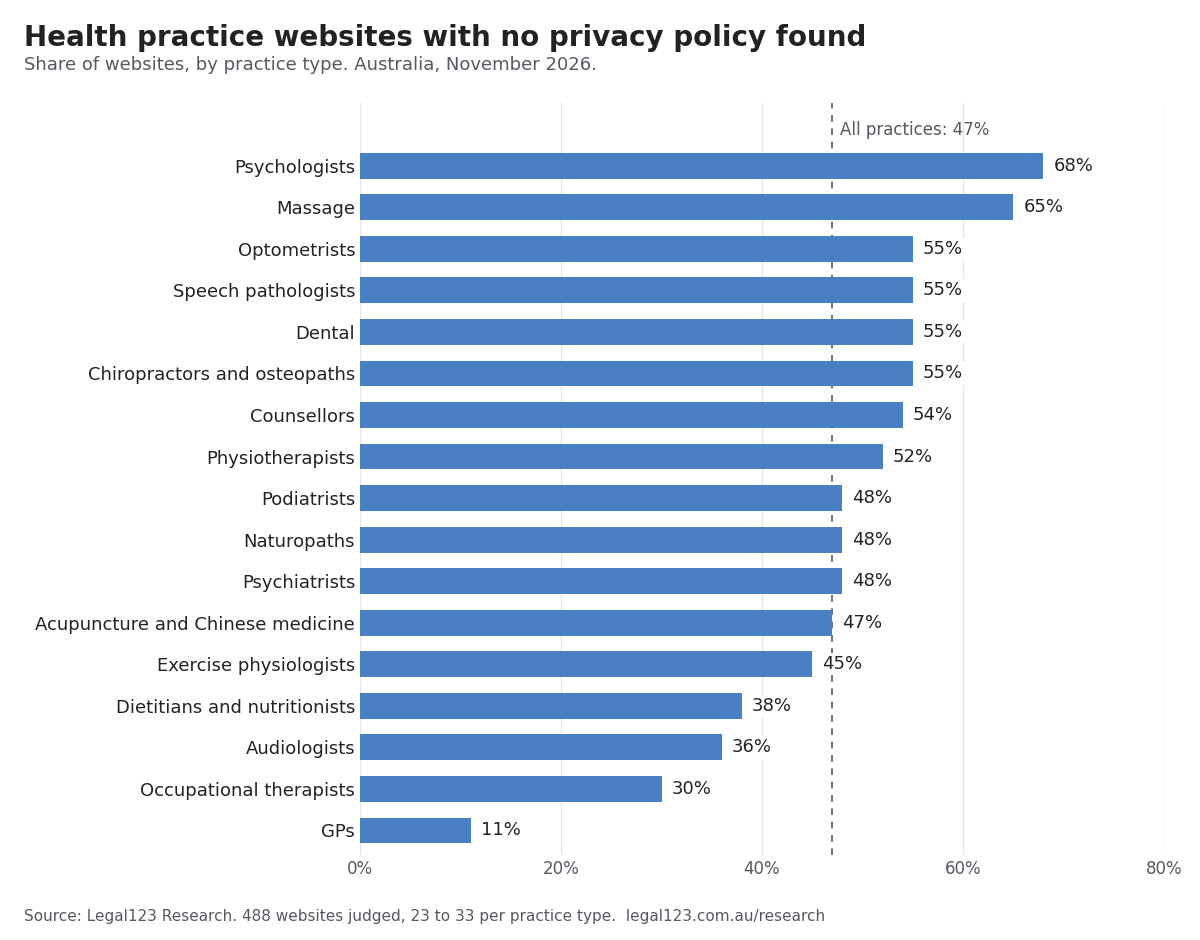
By type of practice
| Practice type | No privacy policy found on the website |
|---|---|
| Psychologists | 68% (17 of 25) |
| Massage | 65% (15 of 23) |
| Optometrists | 55% (16 of 29) |
| Speech pathologists | 55% (17 of 31) |
| Dental | 55% (18 of 33) |
| Chiropractors and osteopaths | 55% (18 of 33) |
| Counsellors | 54% (15 of 28) |
| Physiotherapists | 52% (15 of 29) |
| Podiatrists | 48% (15 of 31) |
| Naturopaths | 48% (12 of 25) |
| Psychiatrists | 48% (12 of 25) |
| Acupuncture and Chinese medicine | 47% (14 of 30) |
| Exercise physiologists | 45% (14 of 31) |
| Dietitians and nutritionists | 38% (9 of 24) |
| Audiologists | 36% (12 of 33) |
| Occupational therapists | 30% (9 of 30) |
| GPs | 11% (3 of 28) |
Across all mental health practices (psychologists, psychiatrists and counsellors), 60% had no privacy policy we could find (32 of 53). For medical practices, the figure was 28% (15 of 53). A likely reason for the GP result is practice accreditation, which asks general practices to keep a privacy policy. Most other practice types have no equivalent prompt.
Each group is small, between 23 and 33 sites, so read these figures as a guide to the pattern and not as precise rates for each profession.
By type of website
| How the site was built | No privacy policy found on the website |
|---|---|
| Do-it-yourself website builders | 63% (109 of 174) |
| WordPress | 38% (81 of 215) |
The website tool does not explain the gap between professions. Among WordPress sites alone, 1 of 19 GP sites had no policy we could find, compared with 7 of 10 psychologist sites.
What Do Published Health Practice Privacy Policies Leave Out?
Two in three published policies carry no date, and one in three never mentions health information. We compared 233 readable policies with the matters OAIC guidance says a privacy policy should cover.
| What the policy did not do | Share of policies |
|---|---|
| Did not show when it was last updated | 67% (156 of 233) |
| Did not say whether information goes overseas | 60% (140 of 233) |
| Did not mention the advertising tracker running on the site | 54% (64 of 118 sites with one) |
| Did not say how long records are kept | 44% (102 of 233) |
| Did not mention health information | 34% (80 of 233) |
| Did not explain how to access or correct a record | 34% (80 of 233) |
| Did not explain how to complain | 34% (79 of 233) |
| Did not give a privacy contact | 19% (44 of 233) |
| Did not state why information is collected | 6% (14 of 233) |
| Did not say how information is collected or stored | 6% (13 of 233) |
One in three policies never mentions health information. That points to a general business template, not a policy written for a health practice. In our experience, this is the most common problem in the policies practices bring to us: the document was written for an online shop.
Advertising trackers go unmentioned. At least 24% of the sites we fetched ran an advertising tracker (126 of 519). These tools can report a visit to an advertising platform. Of the 118 such sites with a policy we could read, 64 said nothing in it about cookies, analytics or tracking. The OAIC’s own review of 50 health provider websites found the same pattern: of the sites using a third-party tracking pixel, 77% did not mention it in their privacy policy.
Some policies were published unfinished. Of the 30 policies we read in full, two still showed the template’s “Suggested text” prompts and one still read “[Insert Date] At [Your Business Name]”. One was a set of instructions written for practitioners. One was a 121-word terms page with “Privacy Policy” in the heading and no privacy content.
Every one of these is counted as a site with a privacy policy in our 47% headline. The real gap is wider than the headline.
Automated decisions. 86% of policies (201 of 233) did not mention automated decisions or AI. That disclosure only applies from 10 December 2026, and only to practices that make such decisions. We report it as a starting point, not as a gap.
What Should a Health Practice Do Now?
Check that your own privacy policy is on your website, then check it against the 12 points below. In order:
- Check that your privacy policy is on your website and linked from every page, usually in the footer.
- Check that it is your own. A booking system’s or software supplier’s policy does not cover your practice.
- Read it. If it doesn’t mention health information, it wasn’t written for a health practice.
- Check it against the 12-point checklist below.
- Before 10 December 2026, work out whether any software you use makes automated decisions about patients, and say so in the policy if it does.

Legal123 Health Practice Privacy Policy
The Legal123 Health Practice Privacy Policy is written for Australian health practices, covers all 12 points below and costs $249 +GST. If your practice has an unusual setup, book a 30-minute call with a lawyer for $99.
For the wider picture, see our guide to the legal requirements for an Australian health practice.
The 12-Point Health Practice Privacy Checklist
- The policy is on the website and linked from the home page.
- It says you collect health information.
- It says how you collect and store information.
- It says why you collect it and how you use it.
- It explains how patients can access and correct their records.
- It explains how to complain, and what happens next.
- It says whether information is sent overseas, and where.
- It gives a privacy contact.
- It shows the date it was last updated.
- It covers cookies, analytics and any advertising tools on the website.
- It covers automated decisions and AI, if you use them.
- It says how long records are kept.
Methodology
What we studied. Public websites of private Australian health practices, checked in November 2026. We looked only at what any visitor can see without logging in or filling in a form.
How the 584 websites were chosen. The selection ran in three steps, each fixed in advance. We selected practices by rule, with no human choice. This is not a strict random sample.
- Practice types. We set 17 practice types and aimed for 35 websites of each.
- Towns. For each type, a computer randomly picked towns and suburbs from three lists: capital cities and their suburbs, mid-sized cities, and regional towns. Larger places had a higher chance of being picked. The sample covers 82 towns and suburbs.
- Practices. In each town, we pulled up to 10 Google Maps listings for that practice type and removed those without a website. Where more remained than we needed, usually two or three per town, a fixed rule based on Google’s internal listing number decided which were kept. No one chose practices by name, reputation or website.
The result was 352 websites from capital cities, 118 from mid-sized cities and 114 from regional towns, with 33 to 35 per practice type.
What was left out. Hospitals, government and public health services, universities, large national chains that share one corporate website and practices whose only web presence was a directory, booking platform or social media page. Practices with no website are not in the study.
How the sites were read. A script fetched each home page and looked for a privacy policy in the page links, on any policies, terms or legal page, and at the standard addresses for a privacy page. Where it found none, it read up to 10 further pages of the site for any privacy wording. Every site with privacy wording on an inner page (38 sites) was then read individually and grouped.
How many sites are in each figure.
| Stage | Sites |
|---|---|
| Chosen | 584 |
| Home page could not be fetched, or site excluded as closed or a placeholder | 65 |
| Home page fetched | 519 |
| Links or inner pages could not be read | 31 |
| Judged for the headline | 488 |
| Policies readable for the content checks | 233 |
How policy content was checked. Each policy was tested against 12 points drawn from the Australian Privacy Principles and OAIC guidance, using written rules that look for the relevant wording. We then read 30 policies in full, one by one. On the 15 that had not been used to refine the rules, the rules agreed with the full reading 94% of the time. Where they disagreed, the rules were more often too generous (8 cases) than too harsh (2). The content gaps are therefore more likely understated than overstated.
How tracking was checked. Tracking tools were detected in each page’s code. Because some sites load these tools only in a live browser, we also opened 118 sites in a browser. Not every site was opened this way, so the tracking figures are minimums.
Checks on the “no policy” result. Ten sites with no policy were re-checked on the live website. Nine were confirmed, and one could not be loaded. A further 10, picked at random, were given to an independent AI research tool with instructions to find a policy. It found none on any of them.
How we use words.
- “No privacy policy found on the website” means exactly that. A practice may have a policy it hands out in the clinic or sends on request. We could not see those and did not count them.
- A short privacy statement is reported as its own group and is never counted as nothing.
- A privacy policy belonging to a booking system or other supplier is not counted as the practice’s policy.
- Findings are gaps against OAIC guidance.
- We make no finding that any practice has breached the Privacy Act.
- No practice is named in this report or anywhere else.
Limits.
- This is a snapshot. Websites change, and some might have added a policy since.
- In larger towns, we saw at most 10 listings per search, so not every practice had a chance of being chosen.
- Groups by practice type are small (23 to 33 sites). They show a pattern, not a precise rate.
- Results by state are not reported. The smaller states and territories had too few sites.
- 96 of the 584 chosen sites could not be fetched or fully read, and are left out of the headline.
- A script reads fewer pages than a person would. A policy placed somewhere unusual could have been missed. The checks above suggest this is uncommon.
- The script, the rules and the full readings were produced with AI assistance and reviewed by Legal123. The full readings were done once and have not been repeated by a second reviewer.
Sources for outside figures. OAIC Notifiable Data Breaches statistics, January to June 2026. OAIC Australian Community Attitudes to Privacy Survey 2026. OAIC review of 50 health service provider websites, published June 2026. OAIC Australian Privacy Principles Guidelines, chapters B and 1.
FAQ: Health Privacy Statistics in Australia
How many Australian health practices have a privacy policy on their website?
About half. In Legal123’s November 2026 review, a privacy policy was found on 53% of the health practice websites that could be read (257 of 488), and none was found on 47%.
What are the latest healthcare data breach statistics for 2026?
Health service providers reported 149 of the 667 data breaches notified to the OAIC between January and June 2026, more than any other sector. Of those 149, 72 were malicious or criminal attacks, and 62 were human error.
I’m a massage therapist or nutritionist. Do I collect health information?
Almost certainly. Asking a client whether they have any pain and where, or whether they have allergies, is collecting health information under the Privacy Act 1988 (Cth). Notes on how a client is feeling, physically or emotionally, count too.
How does the Privacy Act apply to health information?
The Privacy Act 1988 (Cth) treats health information as sensitive information, and it covers every private business that provides a health service and holds health information, whatever its turnover. Our guide to health practice legal requirements explains what that means in practice.
Do patients have a right to access their health information?
Yes. Under Australian Privacy Principle 12, a patient can ask a practice for the personal information it holds about them, with limited exceptions. In this study, 34% of published policies did not explain how to do that.
Can a health practice be penalised for a privacy policy that falls short?
Yes. Since December 2024, the OAIC has been able to issue an infringement notice where a privacy policy does not meet the requirements of Australian Privacy Principle 1.3 or 1.4. Check the OAIC’s website for the current amounts.
Can I quote these statistics?
Yes, with a link to this page. Please cite the study as Legal123 Research, “Health Privacy Statistics Australia 2026”. Data tables are available on request through the Legal123 contact page.
About Legal123
Legal123 is an Australian online law firm providing lawyer-drafted legal templates and custom legal documents for online businesses. Founded in 2009, Legal123 Pty Ltd is an Incorporated Legal Practice regulated by the Law Society of NSW and the Office of the Legal Services Commissioner. Its team of Australian lawyers has served more than 10,200 Australian businesses with fixed-fee legal templates, custom document drafting, contract review, trademark registration and lawyer consultations, delivered online and by phone. Legal123 is rated 4.9 out of 5 across 500+ client reviews (103 on Google).
This report is general information, not legal advice.