
Legal Action Against Web Designers: What to Do When Your Website Designer Will Not Deliver

Quick Answer
Yes, legal action against web designers in Australia is open to any business whose designer has not delivered, and the order that works is:
- Written notice with a deadline, then
- Letter of demand, then
- Claim for breach of contract in your state’s civil tribunal (NCAT, VCAT, QCAT, etc.)
- You get your money back, damages or an order to hand over the site.
Most disputes end at the letter of demand stage. If the designer is overseas, a tribunal order is close to worthless: your leverage is the money you have not yet paid, the platform’s dispute process and a card chargeback.
In our experience working with over 10,000 Australian businesses, the calls we get about website designers follow one pattern: a large payment up front, a site that never launches and the domain, hosting or admin login sitting in the designer’s name. The law is on the client’s side more often than clients expect. The practical problem is proof and leverage, and both are fixable early.
This guide explains what to do when your web designer does not deliver, when it is worth suing, your rights when a designer holds your website or domain hostage, how to change developer without losing the site, what to do when the designer is overseas, and how to prevent the whole thing next time.
Key Takeaways
- Yes, you can take legal action against a web designer who does not deliver. The grounds are breach of contract, and the Australian Consumer Law guarantees that services are provided with due care and skill, are fit for purpose and are completed within a reasonable time. Those guarantees cover a business buying services worth up to $100,000.
- Follow the ladder: document everything, send a written notice with a deadline, send a letter of demand, then file in your state tribunal. Filing fees start around $60 to $260, and most claims of this size do not need a lawyer at the hearing.
- The designer owns the copyright in the design and code until it is assigned to you in writing (Copyright Act 1968). Under auDA’s rules, your business, not the designer, must be the registrant of your .au domain. Get both fixed before the final payment.
- An overseas designer is hard to sue and harder to collect from. Use the platform’s dispute process (Upwork allows refund requests within 180 days of payment), a card chargeback, and the balance you haven’t paid. Then decide whether rebuilding is cheaper than chasing.
- A one-page agreement with milestone payments, IP assignment on payment, and the domain and hosting in your name from day one prevents almost every case we see.
Click on any of the questions below to jump to that section of this legal guide.
Legal issues covered in this guide
What can I do if my web designer does not deliver?
If your web designer does not deliver, the steps that get results, in order, are: put the problem in writing with a deadline, send a formal letter of demand, then make a claim in your state’s civil tribunal. Each step builds the record the next one needs, and most designers settle at step two once they see the client has organised the evidence.
Before any of that, stop paying. A designer who is behind will often ask for the next instalment to “get things moving”. Money already paid is your leverage in reverse; money not yet paid is the only leverage you have.
Step 1. Put the problem in writing and set a deadline
Send one email that sets out what was agreed, what has been delivered, what is missing, a date by which it must be delivered, and what you will do if it is not. Attach or quote the original quote, proposal or agreement and any promised timelines.
This email decides the tribunal outcome months later. In the matter described below, the client could not prove what was delivered or when, and the designer rewrote history. A dated email with a list of deliverables makes that impossible.
Step 2. Send a letter of demand
A letter of demand is a formal letter stating the amount or action you require, the legal basis, a 7- or 14-day deadline, and that you will start proceedings if it is not met. It is the single most effective step in these disputes because it converts a drifting argument into a decision the designer has to make.
Our Letter of Demand template ($99 +GST) is written for exactly this. State the refund or the handover you want, list the deliverables and dates, and give one deadline. Send it by email and post, and keep proof of both.
Can I get my deposit back from a web designer?
Yes, you can usually get a deposit back from a web designer who has delivered nothing of value or has abandoned the job. Under the Australian Consumer Law, a failure to deliver a service with due care and skill or within a reasonable time is a “major failure” when the service is so far short of what was agreed that a reasonable client would not have paid for it, and the remedy for a major failure is to cancel the contract and claim a refund.
A clause calling the deposit “non-refundable” does not override those guarantees. Where the designer has delivered part of the work, the realistic outcome is a refund of the balance above the value of what you can actually use, and that value is often close to zero if the code is unfinished and you cannot access it. If you paid by card, ask your bank about a chargeback for services not provided; most card schemes allow a dispute for around 120 days from the payment, longer where the service was promised for a later date.

Warning
Do not pay the balance to “release” the site. A designer holding an unfinished site will sometimes offer to hand it over on full payment. Once paid, you have no leverage and still no copyright assignment. Payment against a completed handover, with the domain, hosting and admin access in your name, is the only safe order.
Can I take legal action against a web designer?
Yes. Legal action against web designers is available for breach of contract, for failing the Australian Consumer Law guarantees on services, and for misleading conduct where the designer claimed skills, timelines or progress they did not have. For a typical small business website, the claim goes to a state civil tribunal, not a court, and you do not need a lawyer to file it.
What are the legal grounds?
- Breach of contract. The quote, proposal, email chain or signed agreement is the contract. Missed deliverables, missed dates and unfinished work are breaches, and the remedy is damages: what it costs you to get what you paid for elsewhere.
- Australian Consumer Law guarantees. Services must be provided with due care and skill, be fit for any purpose you made known, and be completed within a reasonable time where no time was agreed (sections 60 to 62). A business buying services worth up to $100,000 is a “consumer” for these guarantees, so almost every small business website qualifies.
- Misleading or deceptive conduct. A designer who says they can build a custom feature they cannot, or who reports progress that has not happened, engages in conduct that the Australian Consumer Law prohibits (section 18). This matters when the designer has no written agreement to hide behind.
- Unfair contract terms. A designer’s standard terms that let them keep the site, keep the deposit, or change the scope while you cannot can be void as unfair terms in a small business contract, and using them has attracted penalties since 9 November 2023.
Which tribunal or court hears a website design dispute?
A website design dispute in Australia goes to the civil and administrative tribunal or the small claims list of the Magistrates Court in your state, depending on the amount. The limits below are current as of 30 September 2026; check the tribunal’s site before you file, because they change.
| State or territory | Forum | Claim limit | Notes |
|---|---|---|---|
| NSW | NCAT, Consumer and Commercial Division | $100,000 | Consumer claims about goods and services; conciliation first |
| VIC | VCAT, Civil Claims List | No upper limit | Fees rise with the claim; small claims under $15,000 are cheapest |
| QLD | QCAT, minor civil dispute | $25,000 | Above that, Magistrates Court |
| WA | Magistrates Court, minor case claim | $10,000 | General procedure claims to $75,000 |
| SA | Magistrates Court, minor civil action | $12,000 | SACAT does not hear these |
| TAS | Magistrates Court, minor civil claim | $5,000 | Civil claims to $50,000 in the ordinary list |
| ACT | ACAT, civil dispute | $25,000 | |
| NT | NTCAT, small claims | $25,000 |
Filing fees are modest, typically $60 to $260 for claims of this size; hearings are informal, and the tribunal can order a refund, damages, or that the designer perform a specific act such as handing over files and access. What it cannot do is make a designer with no assets pay.
Is it worth suing a web designer?
It is worth suing a web designer when the money at stake is more than a few thousand dollars, the designer is in Australia, you have a written record of what was agreed and delivered, and the designer is a business that will still exist and have money when you win. Where any of those is missing, stop at the letter of demand and put the effort into the rebuild.
Do the sums honestly. A typical small business site costs $1,500 to $5,000 for a template build and $5,000 to $10,000 for a custom build (Australian agency pricing guides, 2025-2026), which sits inside every tribunal limit above. A tribunal claim takes three to six months and a few hours of your time. Enforcing a judgment against a sole trader who has closed the business takes longer and often returns nothing.

Case Study
An Australian business engaged an Australian designer for a site that needed custom coding. The designer said he could do it, hit technical problems, and trickled out small changes for 18 months. The client paid in phases and had paid 65 per cent of the fee, but had no working website. When the client said they were moving to another developer, the designer refused admin access, disputed what had been agreed and delivered, and then quietly pushed work into the site after being told to stop, muddying the record of progress. The client could not prove what was delivered or when. Both sides eventually walked away, and the client started again with a new developer, having lost 18 months and the head start their idea had.
Three things would have changed the outcome: a dated deliverables list in every payment email, admin access and hosting in the client’s name from day one, and a written stop-work instruction with a demand for a full export the same day.
My web designer is holding my website or domain hostage. What are my rights?
Your rights depend on three separate things: who the domain registrant is, who owns the copyright in the design and code, and whose name is on the hosting account. Clients assume that paying for the site makes all three theirs. Without a written agreement, none of them is.
Who owns my website domain?
The registrant listed on the domain owns the licence to it, and under auDA’s .au licensing rules, the registrant of a .au domain must be the business with an Australian presence, not an agent acting for it. auDA’s guidance since the 12 April 2021 rules is explicit: you or your organisation must be listed as the registrant, not the developer, and you can correct a domain registered in a developer’s name on request.
If the designer registered your domain in their own name, ask them in writing to transfer the registrant to your business. If they refuse, raise it with the registrar and with auDA, and put it in the letter of demand. A domain in the wrong name is also a reason to keep the hosting and the site separate from the designer’s accounts from the start.
Do I always own the design if I pay someone to design it?
No. Paying for a website design does not give you ownership. Under the Copyright Act 1968 (Cth), the person who creates a work owns the copyright in it, and an independent contractor is not covered by the exception that gives employers the copyright in an employee’s work. Copyright passes to you only by an assignment in writing signed by the designer, and the designer keeps moral rights (to be credited and to object to derogatory treatment) unless they consent in writing.
Without an assignment, you hold, at best, an implied licence to use the site for the purpose it was built. That licence is arguable, and it is what a difficult designer relies on when they say you cannot take the code elsewhere. Include an assignment clause in the agreement and make it take effect on final payment.
Can website designs be copyrighted?
Yes. The code is protected as a literary work, the graphics and layout files as artistic works, and the text as literary works, all automatically and without registration. Copyright does not protect the idea of the layout or the look and feel in general, so a new developer can rebuild a similar site from scratch without infringing anything, which is often the practical answer.
How do I get my website files and hosting access back?
Demand them in writing, in a list, with a date. Ask for:
- Full source files and theme
- Database export
- CMS administrator login
- Hosting account or a full site export
- DNS settings
- Any licences and plugin keys purchased for the site, and
- Any email accounts on the domain.
If the designer will not hand them over, include that list in the letter of demand and, if needed, the tribunal application as the specific act you want ordered.
If the hosting is in the designer’s name and they refuse to cooperate, the honest advice is usually to point the domain to new hosting and rebuild, then pursue the money separately. A site you cannot access is not worth a six-month fight while your business has no website.

Did you know?
There are 3,581 web design service businesses in Australia sharing $1.5 billion in revenue, and none of them holds more than 5 per cent of the market (IBISWorld, May 2026). Most website designers are a one-person shop. A tribunal order against one is only worth what that person can pay, which is why the exit checklist below matters more than the claim.
How do I change my website developer without losing the site?
You can change website developers safely by securing control of the domain, hosting and admin access before you tell the outgoing designer, taking a full backup, then terminating in writing and paying only for work actually delivered. The order matters. In the case study above, the client announced the change first, and the designer used the access they still had.
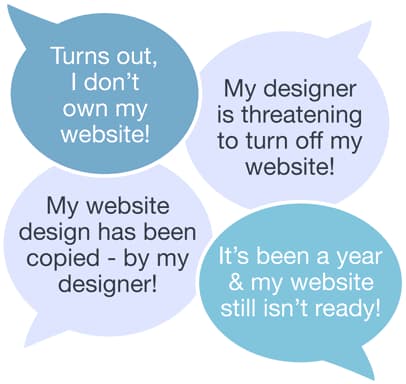
How to fire your web designer
If you have a written agreement, follow its termination clause: give the required written notice and pay for completed milestones. If you have no written agreement, you can still end the engagement by written notice on reasonable terms, paying for work delivered to date and nothing for work not delivered.
Be specific and unemotional. State the engagement end date, the deliverables you require by that date, the access to be handed over, and that no further work is authorised. Send it after you have secured access, not before.
Exit checklist
- Confirm you have a working administrator login and change the password.
- Confirm your business is the domain registrant and you control the DNS.
- Move the hosting into an account in your name, or take a full export of files and database.
- Take a complete backup and store it somewhere the designer cannot reach.
- Collect licences, plugin keys, fonts, stock image licences and any third-party accounts.
- Revoke the designer’s access to everything, including email, analytics and payment gateways.
- Then send the termination notice, with the final payment tied to completing the handover list.
Make sure everything is in your name
Never let an outgoing designer keep any account in their name “for convenience”. Hosting, domain, analytics and payment gateway accounts all belong in your name with your billing details. If they are not, that is the first thing the new developer should fix, before any design work starts.
What if the web designer is overseas?
If your web designer is overseas, Australian law still applies to a contract with an Australian business, but enforcement is a different question. You can obtain a tribunal or court order here; serving it and collecting on it in another country costs more than any small website is worth. Plan for leverage, not litigation.
Can I sue an overseas web designer?
You can sue an overseas web designer in an Australian court or tribunal, and if the designer has assets or a presence in Australia, you can enforce the order. Where the designer’s only presence is a freelancer profile and a bank account in another country, the order is a piece of paper. Registering it in the designer’s home jurisdiction is possible in theory and uneconomic in practice for a claim under $20,000.
What works instead
- The platform’s dispute process. If you hired through Upwork, Freelancer or Fiverr, use it before anything else. Upwork lets a client request a refund within 180 days of a payment and will mediate while funds are in escrow or when the last payment was within 30 days. Fiverr holds funds until the order is marked complete, and orders auto-complete a few days after delivery, so reject an incomplete delivery promptly through the Resolution Centre.
- A chargeback. For card and PayPal payments, dispute the transaction as services not provided. Do it promptly: card schemes generally allow around 120 days from the payment or the promised delivery date.
- The unpaid balance. Whatever remains unpaid is your negotiating position. Offer a clean break: hand over files and access now in exchange for a release of the balance.
- Rebuild locally. Take whatever files and content you can get, register the domain in your name if it is not already, and brief a local developer. In most matters we see, a rebuild costs less than the time already lost.
The price gap explains why these matters happen. Upwork’s global average for web designers is $15 to $30 an hour, compared with $50 to $150 an hour for an Australian freelancer (Upwork and FindDevs rate data, 2026). The gap is real, and so is the cost when a $2,000 build turns into a site you cannot access and a designer you cannot reach. Nothing in this section is a reason not to hire offshore; it is a reason to pay in milestones and hold the domain and hosting yourself. If the person is not an employee, our guide to hiring overseas contractors covers the contract and payment side.
How do I stop this happening next time?
Almost every website designer dispute we see traces back to the same gaps: no written agreement, paying before delivery, and the domain or hosting in the designer’s name. A one-page agreement and a different payment order close all three.
What should a website design agreement include?
- Scope and deliverables in a list, with what “finished” means for each.
- Milestone payments, with the final payment due on handover, not on launch and not up front.
- Assignment of copyright in the design, code and content to you on payment of each milestone, plus moral rights consent.
- Domain and hosting in your name from day one, with the designer given access rather than ownership.
- Handover: source files, database, admin logins, licences and documentation, as listed.
- Warranty: a fix period for defects after launch, at no charge.
- Termination and exit: notice, payment for work done, and an obligation to hand everything over within a set number of days.
Can you provide an example of a web design contract?
Yes. Our Contractor Agreement template ($199 +GST) is written for engaging an Australian independent contractor and covers a website build: deliverables, milestone payments, transfer of intellectual property on payment, confidentiality and termination. If you are the designer rather than the client, our legal guide for web developers and designers covers the other side of the same contract.
For a large or unusual build, custom coding, or a designer overseas, have us draft or review the agreement for the project. Our legal services page covers custom drafting and contract review.
We’re here to help
If you are already in a dispute, the fastest way to know where you stand is a 30-minute call. Book a call with Vanessa Emilio ($99 +GST): bring the agreement or quote, the payment history and the email trail, and you will leave with the next step and a view on whether it is worth pursuing.
Frequently Asked Questions
How much does it cost to hire a website designer?
A template-based small business website costs about $1,500 to $5,000 in Australia, a custom brochure site $5,000 to $10,000, and an ecommerce site $8,000 to $25,000 (Australian agency pricing guides, 2025-2026). Whatever the price, pay it in milestones tied to delivered work.
Is it worth hiring a web designer?
Yes, for most trading businesses, because a professional site converts better and costs less in your time than a DIY build. A DIY builder suits a very simple site on a small budget. Either way, register the domain in your own name before anyone else touches it.
How long should a web designer take to build a website?
Four to twelve weeks is typical for a small business website; a complex custom or ecommerce build can take longer. The number matters less than having a date in writing, because Australian Consumer Law uses a reasonable timeframe when no date is agreed.
What is a reasonable deposit for a website designer?
A deposit of 20 to 50 per cent is normal, with the balance paid in milestones and the final instalment on handover. Paying 100% up front is the single most common feature of the disputes we see.
Can I leave a bad review of my web designer?
Yes, if it is honest and factual. Stick to what happened and what you paid, keep opinion clearly separate from fact, and post it after the dispute is resolved, not during it. An untrue or exaggerated review can expose you to a defamation claim.
Can I report a web designer to Fair Trading or the ACCC?
Yes. Your state consumer protection agency (for example NSW Fair Trading or Consumer Affairs Victoria) can record a complaint and may offer dispute resolution, and the ACCC records reports of misleading conduct. Neither will recover your money for you; that is what the tribunal claim is for.
Further Information
- Employer obligations in Australia: the complete guide
- How to hire an independent contractor
- Contractor vs employee: the ATO and Fair Work tests
- Legal guide for web developers and designers
- 15 workplace policies your business needs
References
- Australian Competition and Consumer Commission, Consumer rights and guarantees (accessed 30 September 2026)
- Australian Competition and Consumer Commission, Unfair contract terms (accessed 30 September 2026)
- NSW Civil and Administrative Tribunal, Consumers and businesses (accessed 30 September 2026)
- auDA, Changes to third-party use of .au domain names (2021)
- Upwork, How to request a refund from a freelancer or agency (accessed 30 September 2026)

About the Author: Vanessa Emilio
Need legal documents written specifically for your business? Vanessa and her team draft custom legal documents for Australian online businesses, or you can book a 30-minute call to talk through what you need.
Disclaimer: We hope you found this article helpful, but please be aware that any information, comments or recommendations are general in nature, do not constitute legal advice and may not be suitable for your specific circumstances. Whilst we try our best to ensure that the information is accurate, sometimes there may be errors or new information that has yet to be included. Any decisions you take based on information on this website are made at your own risk and we cannot be held liable for any losses you suffer. Contact us directly before relying on any of this information.
Book a 30-minute Call with Legal123
Need help with your business from an experienced legal professional? Then book a call with Vanessa Emilio, Practice Director of Legal123.
- Australian lawyer with 20+ years experience
- Ideal for entrepreneurs & business owners
- Advice tailored to your circumstances
- Quick answers to pressing legal questions
- Confidential discussion
- Easy online booking
30-minute Call with Vanessa Emilio, Practice Director $99 +GST